What is GEO (Generative Engine Optimisation) and Key Strategies for Content Relevance
|
Listen to the Article - KM Digital Marketing
Getting your Trinity Audio player ready...
|
Search is changing. Millions of people are now getting their answers directly from AI tools like ChatGPT, Google Gemini, and Perplexity — without clicking a single website. If your content is not showing up in those AI-generated answers, you are missing a growing share of your audience. That is exactly what GEO is designed to fix.

Table of Contents
What is GEO (Generative Engine Optimisation)?
GEO stands for Generative Engine Optimisation. It is the practice of structuring, writing, and presenting your content in a way that makes AI-powered search engines more likely to cite, reference, or surface your website in their generated responses.
Traditional search engines like Google show you a list of links. You click a link and visit the website. But AI-powered engines — called generative engines — work differently. They read content from across the web, process it, and generate a direct answer to your question. They might mention a source, but often the user never visits the actual website.
GEO is about making sure your content is the one these AI engines choose to learn from, quote, and recommend. It is the next evolution of search optimisation, sitting alongside SEO and AEO as a core pillar of modern digital marketing.
✅Definition:
– KM Digital Marketing
Generative Engine Optimisation (GEO) is the process of optimising website content to increase its visibility and citation rate within AI-generated responses produced by tools such as ChatGPT, Google SGE, Gemini, Perplexity, and Copilot.
The term was formally introduced by researchers at Princeton, Georgia Tech, and IIT Delhi in a 2024 study. Their research showed that specific content strategies — such as adding authoritative citations, clear statistics, and fluent writing — can significantly increase how often AI engines cite a given source.

SEO vs AEO vs GEO — Understanding the Difference
Many businesses are familiar with SEO. Fewer know what AEO is, and GEO is the newest of the three. Understanding how they differ is essential before building a strategy around any of them.
| Criteria | SEO | AEO | GEO |
|---|---|---|---|
| Full Name | Search Engine Optimisation | Answer Engine Optimisation | Generative Engine Optimisation |
| Goal | Rank on Google’s blue link results | Appear in featured snippets and voice answers | Get cited by AI-generated responses |
| Platforms | Google, Bing, Yahoo | Google Featured Snippets, Alexa, Siri | ChatGPT, Gemini, Perplexity, Copilot, SGE |
| Output | A ranked list of links | A direct short answer with source | A generated paragraph with possible citation |
| Key Factor | Backlinks, keywords, technical SEO | Structured data, concise answers | Authority, facts, structure, entity clarity |
| Year of Focus | 1990s onwards | 2015 onwards | 2024 onwards |
The important thing to understand is that these three are not competing strategies — they complement each other. A well-optimised piece of content can rank on Google (SEO), appear in a featured snippet (AEO), and get cited by an AI engine (GEO) at the same time. The strategies overlap significantly, which is why getting GEO right also tends to improve your SEO and AEO performance.
Why GEO Matters for Your Business in 2025
You might be wondering — if people are using AI to get answers without clicking websites, does that mean fewer visitors for me? That is a fair concern. But the opportunity GEO presents is larger than the risk it poses.
- 40% of Gen Z use AI tools as their primary search method
- 1B+ monthly active users on ChatGPT alone
- 63% increase in AI search traffic recorded in 2024
- 3x higher trust for brands cited by AI engines
When an AI engine cites your brand or website in its answer, it builds passive brand authority. Users see your name attached to credible, helpful information. Over time, that recognition drives direct traffic, branded searches, and client enquiries — even without a direct click.
Consider two scenarios. A user asks Perplexity: “What is the best digital marketing agency for small businesses in India?” If your website has well-structured, authoritative content about digital marketing for small businesses, Perplexity might cite you. Even if the user does not click your link immediately, they remember your brand name. That is a form of marketing you cannot buy with ads.

❓ Why GEO Matters Right Now?
– Krishnendu Mandal
Businesses that invest in GEO today are building visibility in a channel that will only grow larger. Much like companies that invested in SEO in 2005 built a massive advantage over those who started in 2015, early GEO adopters will have a significant head start in the AI search landscape.
How Generative Engines Work and Find Content
To optimise for GEO effectively, you first need to understand how AI-powered search engines work. They do not simply index pages the way Google does. They process and synthesise information from multiple sources to generate a single, coherent answer.
Here is a simplified explanation of the process:
Retrieval Phase
The AI engine retrieves relevant web pages and documents based on the user’s query. It looks for content that is clearly structured, factual, and topically relevant. Pages with strong schema markup, clean HTML, and clear headings are easier to retrieve correctly.
Reading and Processing Phase
The AI reads the retrieved content and identifies key facts, definitions, statistics, and explanations. Content that is clearly written, logically structured, and free from ambiguity is processed more accurately and is more likely to be used.
Generation Phase
The AI generates a response that synthesises information from its sources. It may quote, paraphrase, or cite specific websites. Authoritative, well-sourced content is more likely to be included in this generated answer.
Citation Phase
Some AI engines like Perplexity and Google SGE display source citations alongside the generated answer. Websites with strong authority signals — such as backlinks, brand mentions, and verified entity data — are preferentially cited.
Understanding these four phases helps clarify why GEO strategies focus heavily on content clarity, factual accuracy, structured data, and domain authority — because each of these elements directly impacts one or more phases of the AI retrieval and generation process.
8 Key GEO Strategies for Content Relevance
The following strategies are based on published research on GEO, best practices from leading digital marketers, and practical experience working with AI-powered search engines. Implement these consistently and your content will be significantly better positioned to appear in AI-generated answers.
Strategy 1 — Build Topical Authority in Your Niche
AI engines do not just evaluate individual pages. They assess the overall authority of your website within a specific topic area. If you consistently publish in-depth, high-quality content on one subject — for example, digital marketing for small businesses — AI engines begin to recognise your site as a reliable source on that topic.
This is called topical authority. It is built by covering a subject comprehensively across multiple related pages and posts, rather than writing random articles about unrelated topics. Create content clusters: one main pillar page on a broad topic, supported by several detailed posts on related sub-topics.
✅Action Step
Map out 10 to 15 subtopics within your main niche. Write a dedicated piece of content for each one. Link them all back to a central pillar page. This structure signals depth and expertise to both Google and AI engines.
Strategy 2 — Write Factual, Verifiable Content with Citations
AI engines are trained to prefer content that is accurate, trustworthy, and backed by evidence. When you include statistics, research findings, and data — and cite where that data comes from — you signal to the AI that your content is reliable.
For example, instead of writing “many businesses are using AI search tools,” write: “According to a 2024 Statista report, over 40% of Gen Z users now use AI tools as their primary method of information retrieval.” The second version is more specific, more verifiable, and far more likely to be cited by an AI engine.
Strategy 3 — Use Clear, Structured Headings Throughout Your Content
AI engines parse content the same way a well-trained editor would — they look at structure first. Use H1 for your page title, H2 for major sections, and H3 for sub-sections within those. Each heading should clearly describe what the section covers, ideally phrased as a keyword or a direct question.
This structure makes it easy for AI systems to extract the most relevant section of your content in response to a specific query — rather than reading your entire page and guessing what is most important.
Strategy 4 — Add Schema Markup to Every Page
Schema markup is code you add to your website that explicitly tells search engines what your content is about. For GEO, the most important schema types are Article, FAQPage, HowTo, Product, LocalBusiness, and BreadcrumbList.
When AI engines crawl your site, structured data helps them correctly categorise and understand your content. It reduces ambiguity and increases the chances of your information being accurately retrieved and cited. If you use WordPress, the Rank Math SEO plugin makes adding schema markup straightforward without writing any code manually.
Strategy 5 — Write Direct Answers to Specific Questions
One of the most powerful GEO tactics is the direct answer approach. For every major section of your content, write a clear, concise answer — ideally 40 to 60 words — immediately after the heading question. This is the paragraph an AI engine is most likely to extract and use.
Think of it this way: if someone asks an AI engine “What is GEO in digital marketing?”, the AI is looking for a paragraph that directly and completely answers that question. A vague, rambling introduction will never be selected. A precise, self-contained answer will be selected almost every time.
Strategy 6 — Establish Clear Entity Signals
In the context of AI search, an entity is any clearly defined person, place, organisation, or concept. AI engines organise knowledge around entities. If your brand is consistently mentioned across the web — in directories, social media profiles, press articles, and review sites — AI engines begin to recognise it as a real, trustworthy entity.
For a business, this means keeping your Name, Address, and Phone number (NAP) consistent everywhere online, maintaining an active Google Business Profile, being listed on trusted directories, and earning mentions (even without links) from credible websites in your industry.
Entity Optimisation Tip
Create an “About Us” page that clearly states who you are, what you do, where you are located, and who you serve. Use your exact business name consistently. Include your founder’s name and credentials. The clearer your entity signals, the more confidently AI engines will reference you.
Strategy 7 — Keep Your Content Fresh and Up to Date
AI engines prioritise recent, updated information — especially for fast-changing topics like digital marketing, technology, finance, and health. A blog post published in 2020 and never updated is far less likely to be cited than a post published recently or clearly marked as updated.
Make it a habit to review your important content every 6 to 12 months. Update statistics, refresh examples, add new sections where relevant, and change the “last updated” date in your schema markup. This signals to AI engines that your content is current and therefore more trustworthy.
Strategy 8 — Write in Clear, Precise, Professional Language
The original GEO research published by Princeton and IIT Delhi found that fluency — the clarity and professional quality of writing — was one of the strongest predictors of whether AI engines would cite a piece of content. Awkward phrasing, grammatical errors, and overly casual language reduce the likelihood of being cited.
This does not mean your content should be complex or filled with jargon. Quite the opposite. The best GEO content is written in plain, professional language that is easy to read for both humans and AI systems. Avoid filler phrases, repetition, and vague statements. Every sentence should carry useful information.
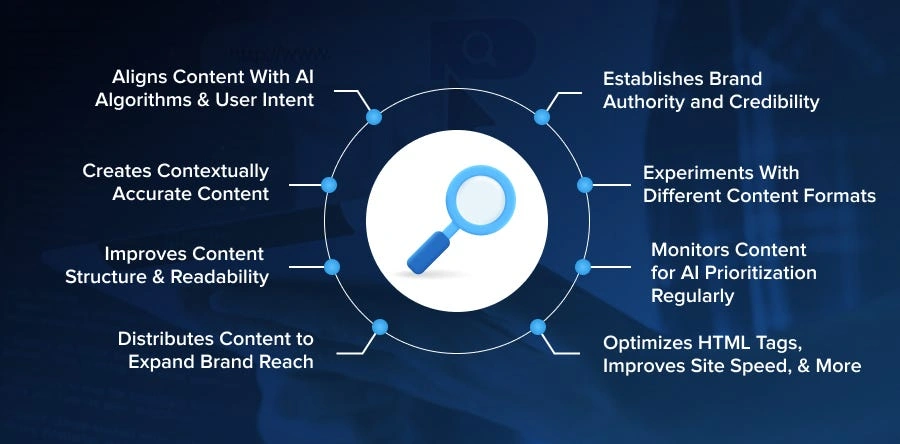
GEO Content Optimisation Checklist
Before publishing any piece of content, run through this checklist to ensure it is fully optimised for generative engine visibility:
- Topical depth: Does your content cover the topic more comprehensively than competing pages? Have you linked to related content on your site?
- Direct answer paragraph: Does each major section open with a concise, self-contained answer that an AI engine could extract and use independently?
- Citations and sources: Have you referenced credible data, research, or studies to support your key claims?
- Schema markup: Is the correct schema type applied — Article, FAQPage, HowTo, or LocalBusiness as appropriate?
- Heading structure: Are your headings clearly organised as H1, H2, and H3 — with descriptive, keyword-rich text at each level?
- Entity signals: Is your brand name, author name, and business details clearly stated and consistent with your Google Business Profile and other directory listings?
- FAQ section: Does your content include a FAQ section with structured question-and-answer pairs, supported by FAQPage schema?
- Content freshness: Is your content recently published or clearly dated as updated? Have you removed outdated statistics or examples?
- Writing quality: Is the content written in clear, grammatically correct, professional language — without filler, jargon, or unnecessary repetition?
- Technical foundation: Does the page load quickly, work well on mobile, and use HTTPS? Technical issues reduce crawl quality for both traditional and AI search engines.
Common GEO Mistakes to Avoid
Understanding what not to do is just as important as knowing what to do. These are the most common errors businesses make when approaching GEO for the first time.
Mistake 1 — Treating GEO as Separate from SEO
Many businesses assume GEO requires a completely different strategy from SEO. In reality, the foundations are largely the same — quality content, technical accuracy, clear structure, and genuine authority. GEO is an extension of good content strategy, not a replacement.
Mistake 2 — Publishing Thin, Surface-Level Content
AI engines have access to thousands of sources. A 300-word blog post with generic information will never be chosen over a comprehensive, well-sourced guide. If your content does not offer something genuinely useful, specific, or unique, it will simply not be cited.
Mistake 3 — Ignoring Schema Markup
Schema markup is one of the clearest signals you can give to AI systems about what your content is and who it is for. Skipping schema markup because it seems technical is leaving significant GEO visibility on the table. Use a plugin like Rank Math on WordPress to implement it without writing code.
Mistake 4 — Inconsistent Brand and Entity Information
If your business name is written differently on your website, Google Business Profile, JustDial, and LinkedIn, AI engines struggle to confirm you are a real, trustworthy entity. This inconsistency directly reduces the likelihood of being cited. Standardise your NAP information across every platform immediately.
Mistake 5 — Never Updating Old Content
Content that was accurate in 2022 may be partially or entirely outdated by 2025. AI engines are trained to prioritise fresh, accurate information. Review and refresh your most important pages at least once a year. Update statistics, remove outdated references, and revise the publication date in your schema markup.
What is GEO in Digital Marketing?
GEO stands for Generative Engine Optimisation. It is the practice of optimising your content so that AI-powered tools like ChatGPT, Google Gemini, and Perplexity cite and reference your website when generating answers to user queries. It is one of the three pillars of modern search optimisation, alongside SEO and AEO.
Difference between AEO, GEO and SEO
SEO helps your website rank on traditional search engine results pages like Google. AEO (Answer Engine Optimisation) helps your content appear as direct answers in featured snippets and voice search responses. GEO (Generative Engine Optimisation) helps your content get cited within AI-generated answers from tools like ChatGPT, Gemini, and Perplexity. All three are complementary and share many of the same foundational practices.
Why GEO is important in 2026?
AI-powered search tools are now used by hundreds of millions of people every month. If your content is not optimised for GEO, your brand becomes invisible in these fast-growing channels. Being cited by an AI engine builds passive brand authority, drives branded searches, and establishes trust — even when users do not click through to your website directly.
Does GEO replace traditional SEO?
No. GEO does not replace SEO — it builds on top of it. Strong SEO fundamentals such as good keyword targeting, quality backlinks, fast page speed, and mobile-friendliness remain essential. GEO adds an additional layer of optimisation that makes your content visible in AI-generated search responses, which are increasingly becoming the first point of contact between a user and information.
Conclusion — Start Optimising for the Future of Search
GEO is not a trend to watch from the sidelines. It is a fundamental shift in how people find information online, and it is already affecting businesses today. The good news is that the strategies behind GEO — factual content, clear structure, topical authority, schema markup, and strong writing — are the same principles that make content genuinely excellent.
If you focus on being the most helpful, most credible, and most clearly structured source on your topic, you will not just rank on Google. You will get cited by the AI engines that are shaping the future of search.
At KM Digital Marketing, we help businesses across India implement SEO, AEO, and GEO strategies that build long-term online visibility. If you would like a free content audit or consultation, reach out to us today.
References: Wikipedia