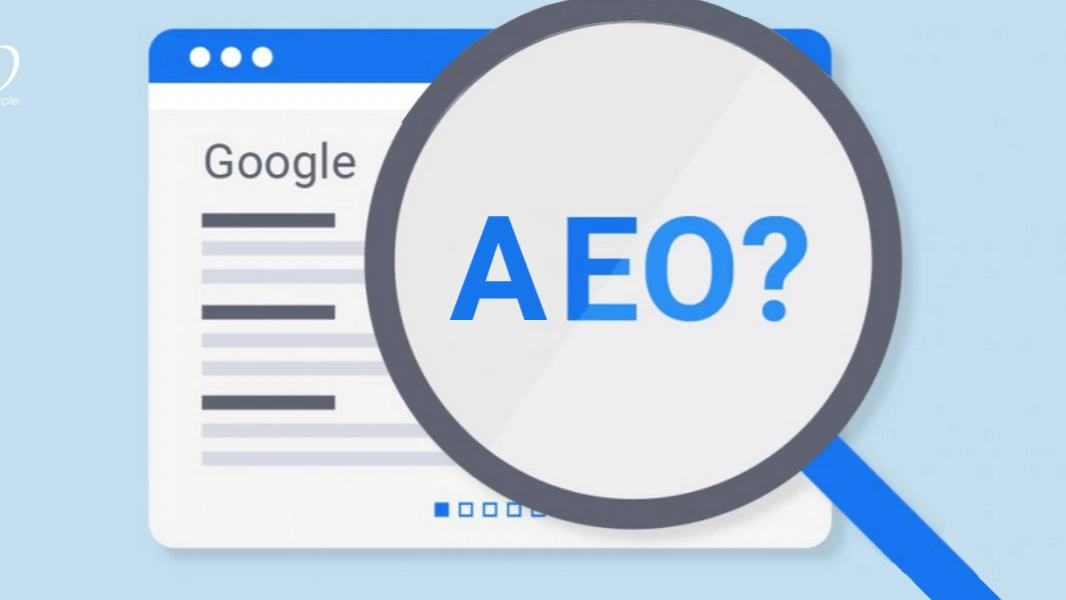
What is AEO (Answer Engine Optimization)?
|
Listen to the Article - KM Digital Marketing
Getting your Trinity Audio player ready...
|
Search is no longer just about clicking links. Today, AI-powered engines answer your questions directly. If your website is not optimised for this shift, you are already losing visibility — even if you rank on page one of Google.

Table of Contents
Not long ago, doing SEO meant ranking your website on page one of Google and waiting for people to click your link. That model still matters, but something significant has changed.
Today, when someone searches “how to register a company in India” or asks Alexa “what is the GST rate for textiles”, they expect an immediate, direct answer — not a list of ten links to explore. AI-powered search engines now generate those answers automatically, pulling information from websites they consider credible and well-structured.
This is exactly where Answer Engine Optimization (AEO) comes in. And in 2025, it has become one of the most important skills in digital marketing.
What is Answer Engine Optimization (AEO)?
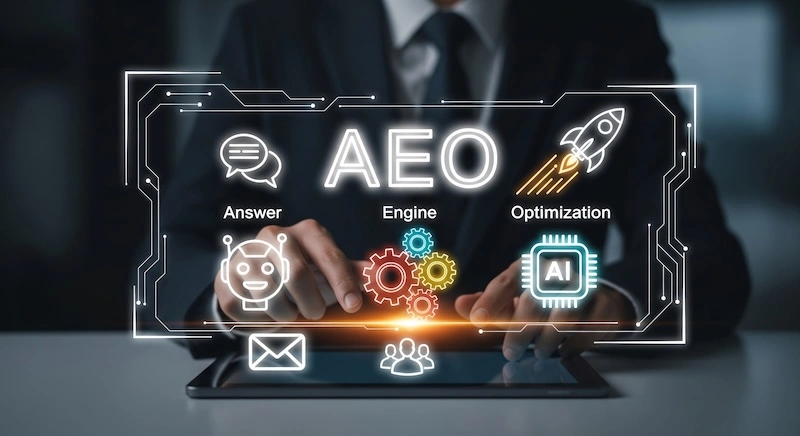
Answer Engine Optimization (AEO) is the process of structuring and optimising your website content so that AI-powered search engines and answer engines can extract your content and present it as a direct, accurate answer to a user’s question.
In simpler words — AEO is about making your content easy for AI to read, understand, and use as an answer.
Traditional search engines like Google show a list of links. Answer engines — including Google’s AI Overviews, Perplexity AI, ChatGPT Search, Microsoft Copilot, Siri, and Alexa — go one step further. They read multiple sources, extract the most relevant answer, and present it directly to the user, sometimes without the user ever visiting a website.
Key Definition:
– Krishnendu Mandal
Answer Engine Optimization (AEO) is the practice of writing and structuring content so that AI-powered search tools — such as Google SGE, Perplexity, voice assistants, and chatbots — can select your content as a trusted, direct answer to user queries.
The term “answer engine” was coined to describe this new category of search tools that prioritise giving answers over listing links. Google’s Featured Snippets, AI Overviews, and People Also Ask boxes are all examples of answer engine results within Google’s own search page.
Why AEO Matters More Than Ever in 2025
The way people search online is changing faster than at any other point in the history of the internet. Here is why AEO has become so critical:
- 50% of searches are now voice or conversational queries
- 40% of Google searches result in zero clicks due to direct answers
- 3x more traffic earned by content featured in AI Overviews vs standard results
- 200M+ active users on AI search tools like Perplexity and ChatGPT Search
These numbers tell a clear story. People are no longer just searching — they are asking. And when they ask, they want an answer, not a list of options to sift through.
For businesses and content creators, this creates both a challenge and an opportunity. The challenge is that traditional page-one rankings no longer guarantee visibility. The opportunity is that if your content is well-structured for AEO, a single article can be surfaced across Google Featured Snippets, People Also Ask, voice results, and multiple AI platforms simultaneously.
Why This Matters for Businesses
India has one of the fastest-growing voice search markets in the world, driven by regional language queries and smartphone usage. Optimising for AEO allows Indian businesses to capture this rapidly expanding audience across Hindi, Bengali, Tamil, Telugu, and other local language searches — not just English.
How Answer Engines Work
To optimise for answer engines, you need to understand how they work. While the technology is complex, the core process follows a recognisable pattern:
Query Understanding
The answer engine analyses the user’s question and identifies the type of answer needed — a definition, a list, a step-by-step process, a comparison, a fact, or an opinion.
Content Crawling and Indexing
The engine searches its index of web pages, prioritising content that is authoritative, structured, and clearly written. Schema markup, headings, and content organisation play a major role here.
Answer Extraction
The engine extracts the most relevant passage from the best-matching content. Concise, clearly written answers in the 40–60 word range are most likely to be extracted.
Answer Presentation
The extracted answer is presented to the user — as a featured snippet, an AI Overview paragraph, a voice response, or a citation within a chatbot’s response.
Source Attribution
Most answer engines cite or link back to the source website. Appearing as a cited source builds your brand’s authority and drives referral traffic, even if the user didn’t initially click through.

AEO vs SEO — What is the Difference?
SEO and AEO are closely related, but they target different outcomes. Understanding the distinction is essential for building a complete digital marketing strategy in 2025.
| Aspect | Traditional SEO | AEO (Answer Engine Optimization) |
|---|---|---|
| Primary Goal | Rank higher in search result pages (SERPs) | Get content selected as a direct answer |
| Target Platform | Google, Bing search results | AI Overviews, Featured Snippets, voice assistants, AI chatbots |
| User Behaviour | User clicks a link to visit your page | User receives answer directly, sometimes without clicking |
| Content Format | Long-form content, keyword-rich pages | Clear questions, concise direct answers, structured data |
| Key Signals | Backlinks, authority, keyword density, page speed | Content clarity, schema markup, answer structure, topical authority |
| Success Metric | Page ranking position, organic click-through rate | Featured snippet appearances, AI citations, voice answer selection |
| Query Type | Short keywords — “best SEO agency India” | Conversational questions — “what is the best SEO agency for small business in India?” |
The critical point is that AEO does not replace SEO — it extends it. Good SEO gets your content discovered. Good AEO gets your content selected as the answer. In 2025, you need both.
Important
You cannot do effective AEO without a solid SEO foundation. Google and other answer engines only pull content from websites they already trust and have indexed. Strong domain authority, clean technical SEO, and quality backlinks all support AEO performance.
AEO vs GEO — What is the Difference?
You may have also heard the term GEO (Generative Engine Optimization). It is closely related to AEO, but targets a slightly different context.
| Aspect | AEO | GEO |
|---|---|---|
| Full Name | Answer Engine Optimization | Generative Engine Optimization |
| What It Targets | Direct answers in search engines, voice assistants, and AI search tools | Citations and references inside AI-generated long-form content |
| Primary Tools | Google Featured Snippets, People Also Ask, Perplexity, Siri, Alexa | ChatGPT, Google Gemini, Claude, Microsoft Copilot |
| User Journey | User asks a question, gets a short direct answer with a source link | User asks AI to write content, AI references your website as a source |
| Content Goal | Be the best short answer to a specific question | Be the most credible, citable source on a topic |
In practice, AEO and GEO strategies overlap significantly. Content that is well-structured, factually accurate, and clearly written tends to perform well in both contexts. At KM Digital Marketing, we recommend optimising for SEO, AEO, and GEO together — which is exactly what a modern content strategy should do.
Types of AEO Results You Can Target
AEO is not a single result type. There are several different placements your content can win through effective AEO:
1. Featured Snippets
Featured snippets appear at the very top of Google’s search results, above all other organic results — often called “Position Zero”. They display a short extract from a web page that directly answers the search query. There are three main types: paragraph snippets (a short answer), list snippets (numbered or bullet lists), and table snippets (comparison data in table format).
2. People Also Ask (PAA) Boxes
These are expandable question-and-answer boxes that appear within Google’s search results. Each question, when clicked, reveals a short answer pulled from a web page. Appearing in PAA boxes across multiple related questions can significantly increase your content’s visibility without additional page rankings.
3. AI Overviews (Google SGE)
Google’s AI Overviews generate a synthesised answer at the top of search results using multiple web sources. If your content is cited as a source in an AI Overview, you gain visibility and a link even if your page is not in the top 10 organic results.
4. Voice Search Answers
When someone asks Siri, Alexa, or Google Assistant a question, the assistant reads aloud a single answer from a single source. If your content is chosen, you get 100% of that audio query. Voice-friendly content is concise, conversational, and directly answers a specific question.
5. AI Chatbot Citations
Tools like Perplexity AI, ChatGPT with web browsing, and Microsoft Copilot actively cite sources when answering questions. Being cited by these tools drives brand awareness and referral traffic.
How to Optimise Your Content for AEO
Now that you understand what AEO is and why it matters, here are the practical steps to start optimising your content for answer engines:
Research Question-Based Keywords
AEO is driven by questions. Your keyword research should shift from short phrases like “SEO tips” to full conversational questions like “what are the best SEO tips for small businesses in India?” Use tools like AnswerThePublic, Google’s autocomplete, and the People Also Ask boxes to find the exact questions your audience is asking.
Write Clear, Direct Answers Immediately
For every major question your content addresses, write a clear answer within the first two to three sentences after the heading. Do not bury the answer in a long introduction. Answer engines extract the most direct, concise answer — which means your answer needs to come before your explanation, not after it.
AEO Content Rule
Write your answers in 40 to 60 words for the best chance of appearing as a featured snippet. This is long enough to be useful and short enough to fit in an answer box. Think of it as writing for someone who only has 15 seconds to read your answer.
Use a Clear Heading Structure
Structure your content with a logical hierarchy of headings. Your H1 should state the page’s primary topic. H2 headings should be major subtopics or questions. H3 headings should cover specific details within each section. Phrase your H2 and H3 headings as questions wherever it makes sense — this directly aligns your content with conversational search behaviour.
Add an FAQ Section to Every Article
FAQ sections are one of the most effective AEO tools available. They directly match the question-and-answer format that answer engines look for. Every FAQ section should be backed by FAQ Schema markup so that Google can read and extract individual questions and answers programmatically.
Build Topical Authority
Answer engines favour websites that demonstrate deep expertise on a subject. Instead of writing one broad article about digital marketing, write ten interconnected articles covering every aspect of it — SEO, AEO, GEO, content marketing, social media, email marketing, and more. This signals to Google that your website is a trusted, comprehensive source on the topic.
Use Structured Data (Schema Markup)
Schema markup is code added to your website that helps search engines understand your content’s meaning, not just its words. For AEO, the most important schema types are Article, FAQPage, HowTo, and QAPage. If you use WordPress, the Rank Math SEO plugin makes adding schema markup straightforward with no coding required.
Write in Plain, Conversational Language
Voice searches and AI queries tend to use natural, conversational language. Your content should match this. Write at a level that a first-year college student can understand. Avoid excessive jargon, unnecessarily long sentences, and passive voice. Simple, clear writing performs better in both AEO and traditional SEO.
Optimise for Mobile and Page Speed
Most voice searches happen on mobile devices. A slow or poorly designed mobile website will not be favoured by answer engines. Ensure your site loads in under three seconds on mobile, is fully responsive, and passes Google’s Core Web Vitals assessment. These technical factors directly influence whether your content gets selected as an answer.
The Role of Schema Markup in AEO
Schema markup — also called structured data — is one of the most powerful tools for AEO. It is a type of code that you add to your website’s pages to help search engines understand exactly what your content means.
For example, without schema, Google reads the text “How long does SEO take?” as a string of words. With FAQ Schema markup, Google understands that this is a question, that the following paragraph is its answer, and that together they form a Q&A pair that can be extracted and displayed directly in search results.
The Most Important Schema Types for AEO
- Article Schema: Tells Google that your page is an article, who wrote it, when it was published, and what it covers. Builds credibility and helps with AI citation.
- FAQPage Schema: Marks up your FAQ section so each question and answer can be extracted individually by Google and AI engines. This is the single highest-impact schema type for AEO.
- HowTo Schema: Used for step-by-step guides. Tells Google the sequence of steps, allowing it to display them as a rich result directly in search.
- QAPage Schema: For community question-and-answer pages. Used when a question has multiple answers from different contributors.
- BreadcrumbList Schema: Helps Google understand your website’s structure and navigation hierarchy. Supports both GEO and local SEO signals.
- Organisation Schema: Tells Google about your business — name, location, contact details, and website. Important for local AEO and knowledge panel eligibility.
⛔Note for WordPress Users
If your website runs on WordPress, the Rank Math SEO or Yoast SEO plugin can add most of these schema types without any coding. Simply fill in the relevant fields in the plugin’s interface and the schema is generated automatically.
Common AEO Mistakes to Avoid
- Burying the answer: Writing three paragraphs of context before giving the actual answer. Answer engines scan for direct answers — put yours first, then explain.
- No schema markup: Without structured data, your content is much harder for AI to interpret accurately. Schema is not optional for serious AEO — it is essential.
- Writing only for long keywords: AEO rewards natural, conversational question phrasing. If your content does not contain the actual questions users are asking, it cannot be selected as an answer to those questions.
- Ignoring mobile performance: Voice search and AI search are predominantly mobile activities. A slow or broken mobile experience disqualifies your content from being selected as an answer.
- No FAQ sections: FAQ sections are the simplest, most direct way to create AEO-ready content. Every blog post covering an information-based topic should include one.
- Thin content: A 300-word page has very little chance of being selected by an answer engine. Answer engines prefer content that demonstrates real depth and expertise on a topic.
- Not updating old content: Outdated information is rarely selected as an answer. Review and refresh older articles regularly, especially on fast-changing topics like digital marketing, finance, or technology.
- Treating AEO as separate from SEO: AEO is not a replacement strategy — it is an extension of SEO. Technical SEO, backlinks, and domain authority all still influence whether your content is trusted enough to be selected as an answer.
What is AEO?
Answer Engine Optimization (AEO) is the practice of structuring your website content so that AI-powered search engines and answer engines — like Google SGE, Perplexity, Siri, and Alexa — can extract and present your content as a direct answer to user questions. It focuses on how content is written and structured, not just where it ranks.
Why AEO is important in 2026?
AEO is important in 2026 because AI-powered search tools — including Google’s AI Overviews, Perplexity AI, and ChatGPT Search — now answer a significant percentage of search queries directly. If your content is not structured for AEO, you lose visibility even when you rank well. Businesses and publishers that invest in AEO now will build a durable competitive advantage as AI search continues to grow.
Does AEO replace SEO?
No. AEO does not replace SEO — it builds on top of it. You need strong SEO fundamentals (technical health, backlinks, domain authority) before AEO can work effectively. Answer engines only select content from websites they already trust and have indexed. Think of AEO as the next layer of optimisation after your SEO foundation is in place.
What is Schema markup?
The most important schema types for AEO are FAQPage, Article, HowTo, and QAPage. FAQPage schema is particularly impactful because it allows Google to extract individual questions and answers from your content and display them in People Also Ask boxes and AI Overviews. WordPress users can implement these easily through Rank Math SEO or Yoast SEO plugins.
Final Thoughts: AEO is the Future of Search Visibility
The shift from search engines to answer engines is not a trend — it is a structural change in how information is consumed online. People are asking more questions, expecting instant answers, and using AI tools that bypass traditional search results entirely.
Answer Engine Optimization is how you stay visible in this new reality. It does not require abandoning everything you know about SEO. It requires extending your strategy — writing clearer content, structuring it more thoughtfully, adding schema markup, and building genuine expertise on the topics that matter to your audience.
At KM Digital Marketing, we help businesses across India build content strategies that are optimised for SEO, AEO, and GEO together. If you want your website to be ready for the future of search, we are here to help.