.jpg)
Most people who want to get into digital marketing face the same problem. They search online, find a sea of confusing terms — SEO, PPC, SMM, SEM, CRO, email funnels, affiliate links — and have absolutely no idea where one thing ends and another begins.
The truth is, digital marketing is not one single skill. It is a family of connected disciplines, each with its own tools, strategies, and career paths. When you understand the individual branches of digital marketing clearly, everything else starts to make sense — the job roles, the platforms, the terminology, and the career opportunities.
This guide breaks down all the major branches of digital marketing in plain, simple language. No jargon. No fluff. Just clear explanations, real examples, and practical guidance for students, bloggers, freelancers, and business owners in India.
Quick Answer
The major branches of digital marketing include Search Engine Optimisation (SEO), Search Engine Marketing (SEM), Social Media Marketing (SMM), Content Marketing, Email Marketing, Affiliate Marketing, Influencer Marketing, Video Marketing, Mobile Marketing, Performance Marketing, Conversion Rate Optimisation (CRO), and Marketing Analytics. Each branch serves a distinct purpose in the digital marketing ecosystem.
Table of Contents
- What Is Digital Marketing?
- Why Understanding Each Branch Matters
- The 12 Major Branches of Digital Marketing
- SEO
- SEM and PPC
- Social Media Marketing
- Content Marketing
- Email Marketing
- Affiliate Marketing
- Influencer Marketing
- Video Marketing
- Mobile Marketing
- Performance Marketing
- Conversion Rate Optimisation
- Marketing Analytics
- How the Branches of Digital Marketing Work Together
- Which Branch Should You Learn First?
- Branches of Digital Marketing: Quick Comparison Table
- Common Misconceptions
- Expert Tips
- Frequently Asked Questions
- Conclusion
What Is Digital Marketing?
Digital marketing is the practice of promoting products, services, brands, or ideas through digital channels — primarily the internet. Unlike traditional marketing, which relies on newspapers, television, and hoardings, digital marketing uses websites, search engines, social media, email, and mobile apps to reach people.
The Indian digital marketing industry is growing at an extraordinary pace. India had over 900 million internet users in 2025 and is projected to cross 1.2 billion by 2028. Every business, from a street food brand in Lucknow to a software startup in Pune, now needs some form of digital presence to compete.
This is exactly why understanding the distinct branches of digital marketing has become a critical skill for students, entrepreneurs, and working professionals across India.
Why Understanding Each Branch Matters
Many beginners make the mistake of treating digital marketing as one big subject to learn in one go. That approach almost always leads to overwhelm and abandonment.
Each branch of digital marketing is its own specialised field. An SEO expert and a performance marketer do completely different work, use different tools, and solve different problems. Knowing which branch suits your skills and goals saves months of wasted effort.
For businesses, understanding the branches helps you make smarter investment decisions. Instead of spending money on every channel simultaneously, you can identify the two or three branches that are most likely to deliver results for your specific business type.
The 12 Major Branches of Digital Marketing
.jpg)
1. Search Engine Optimisation (SEO)
SEO is the process of improving a website's visibility in unpaid (organic) search results on Google, Bing, and other search engines. When someone types "best protein powder in India" into Google and your article appears on the first page without you paying for that placement, that is SEO working.
SEO has three core components. On-page SEO involves optimising the content, headings, keywords, images, and internal links within your website. Off-page SEO is about building authority through backlinks from other reputable websites. Technical SEO focuses on the backend of your site — page speed, mobile friendliness, crawlability, and structured data.
For Indian bloggers and small businesses, SEO is the most cost-effective long-term marketing strategy available. It takes 3 to 6 months to show results but compounds significantly over time.
SEO professionals in India earn Rs. 15,000 to Rs. 1,50,000 per month depending on experience and the type of clients they work with.
Best Free Resource: Google Search Central and Moz's Beginner Guide to SEO
2. Search Engine Marketing (SEM) and Pay-Per-Click (PPC) Advertising
If SEO is the organic way to appear on Google, SEM is the paid way. SEM involves running advertisements on search engines so your website appears at the top of results immediately, without waiting months for organic rankings.
Google Ads is the most widely used SEM platform in India. You select specific keywords, write ad copy, set a budget, and pay only when someone clicks your ad. This is why it is also called Pay-Per-Click or PPC advertising.
SEM is powerful for businesses that need immediate results. A new e-commerce store cannot wait six months for SEO to kick in — running a Google Ads campaign can drive targeted buyers to the store from day one.
The key difference between SEO and SEM is simple. SEO is free to execute (but takes time) while SEM requires a paid budget (but delivers immediate traffic). The best digital marketing strategies use both together.
Google Ads specialists in India are among the highest-paid digital marketing professionals, earning Rs. 30,000 to Rs. 2,50,000 per month.
3. Social Media Marketing (SMM)
Social Media Marketing involves promoting a brand, product, or service through social platforms like Instagram, Facebook, LinkedIn, Twitter (now X), YouTube, and WhatsApp.
India is one of the world's largest social media markets. As of 2025, India had over 462 million Facebook users, 362 million Instagram users, and over 500 million WhatsApp users. This makes social media one of the most impactful branches of digital marketing for Indian businesses.
SMM breaks down into two sub-categories. Organic social media involves creating and publishing free content — posts, reels, stories, and carousels — to build an audience over time. Paid social media involves running targeted advertisements on platforms like Meta Ads (Facebook and Instagram) to reach specific audiences based on demographics, interests, and behaviour.
An interesting distinction from global markets is that WhatsApp plays a much larger role in Indian business communication than in most Western countries. Many Indian small businesses run their entire customer relationship and even sales process through WhatsApp Business, making WhatsApp marketing a uniquely powerful channel here.
Micro-influencer collaborations on Instagram and YouTube have also proven highly effective for Indian D2C brands in 2025-26, with engagement rates of 5 to 8% compared to just 1 to 2% for large celebrity accounts.
4. Content Marketing
Content marketing is the practice of creating and distributing valuable, relevant information — blog posts, videos, podcasts, infographics, eBooks, case studies — to attract, educate, and convert a specific audience.
Content marketing is different from advertising. Advertising interrupts people with a sales message. Content marketing pulls people in by giving them something useful before asking for anything in return.
A health blog that publishes detailed, well-researched articles on weight loss and fitness is practising content marketing. A fintech company that creates a free guide on "How to File ITR as a Freelancer in India" is practising content marketing. The strategy is to earn trust through value, which eventually leads to sales, subscriptions, or conversions.
Content marketing works hand-in-hand with SEO. Great content that answers real questions ranks well on Google. That organic traffic then builds brand awareness and drives conversions over time.
For bloggers, content marketing is not just a strategy — it is the entire business model. HubSpot's Marketing Blog is one of the best global examples of content marketing done at scale.
5. Email Marketing
Email marketing involves sending targeted, personalised messages directly to a list of subscribers. Despite being one of the oldest branches of digital marketing, it consistently delivers the highest return on investment of any digital channel.
Research from multiple marketing studies shows that email marketing generates an average return of Rs. 3,600 for every Rs. 100 spent. No other digital marketing channel comes close to that ratio.
Email marketing works through four main types of campaigns. Welcome emails are sent when someone subscribes to your list for the first time. Newsletter emails deliver regular updates, blog posts, or value-packed content. Promotional emails announce sales, discounts, or product launches. Automated email sequences (also called drip campaigns) send a series of timed emails based on a subscriber's behaviour.
In India, tools like Mailchimp, ConvertKit, and the free version of MailerLite are popular for beginners. Businesses with larger lists often use tools like SendinBlue or ActiveCampaign.
The biggest mistake Indian bloggers and businesses make with email marketing is not starting their email list early enough. Every visitor who leaves your website without subscribing is a potential customer you may never reach again.
6. Affiliate Marketing
Affiliate marketing is a performance-based branch of digital marketing where you earn a commission for promoting someone else's product or service. When someone clicks your unique affiliate link and makes a purchase, you earn a percentage of that sale.
For bloggers and content creators in India, affiliate marketing is one of the most popular and accessible ways to earn passive income online. Amazon Associates, HealthKart's affiliate programme, Flipkart Affiliates, and ClickBank are among the most commonly used platforms in India.
The beauty of affiliate marketing is that you do not need to create your own product, handle payments, manage inventory, or deal with customer service. You simply recommend products that are relevant to your audience and earn a cut of every sale you generate.
A health blogger who writes a detailed review of a creatine supplement and includes an affiliate link to purchase it on Amazon earns a commission every time a reader buys through that link. The commission ranges from 3% for physical products on Amazon to as high as 50 to 75% for digital products on platforms like ClickBank.
The key to succeeding in affiliate marketing is trust. Readers must believe that your recommendations are genuine and not just driven by commission. Always recommend products you have actually used or thoroughly researched.
7. Influencer Marketing
Influencer marketing involves partnering with individuals who have a significant and engaged following on social media or content platforms to promote your brand, product, or service.
The Indian influencer marketing industry has evolved dramatically. Brands are now shifting from mega-influencers with millions of followers to micro-influencers with 10,000 to 1,00,000 followers. Why? Because micro-influencers in India consistently deliver higher engagement rates, more genuine audience trust, and significantly better cost-per-acquisition metrics.
A fitness brand collaborating with a Pune-based fitness coach who has 45,000 loyal Instagram followers will likely see better results than paying a Bollywood celebrity with 5 million followers and low category relevance.
For businesses in India, platforms like YouTube, Instagram, and increasingly LinkedIn are the primary channels for influencer marketing campaigns. Niche influencers in categories like personal finance, health and fitness, education, and technology tend to deliver the best results.
8. Video Marketing
Video marketing is the use of video content to promote and market products, services, or brands. YouTube is the obvious platform, but video marketing now spans Instagram Reels, Facebook Videos, LinkedIn videos, WhatsApp Status, and short-form content on emerging platforms.
India is a video-first internet market. Indian users consume an average of 8 billion videos per day across platforms. For brands and content creators, this means video is no longer optional — it is one of the most powerful tools available.
Video content works across all stages of the buyer journey. Explainer videos help people understand a product or concept. Tutorial videos build trust and demonstrate expertise. Testimonial videos provide social proof. Short-form Reels and YouTube Shorts drive rapid discovery and brand awareness.
The practical barrier for Indian content creators has dropped significantly. A smartphone with decent lighting is all you need to start. Production quality matters less than consistency, authenticity, and the value your videos provide.
9. Mobile Marketing
Mobile marketing targets users on their smartphones and tablets through SMS, push notifications, in-app advertisements, mobile-optimised websites, and messaging apps like WhatsApp.
India has over 750 million smartphone users, and a significant portion of those users access the internet exclusively through mobile devices. This makes mobile marketing one of the most critical branches of digital marketing specifically for the Indian market.
Mobile marketing strategies include SMS campaigns for promotional offers, WhatsApp Business messaging for customer support and relationship building, push notifications from mobile apps, and mobile-specific Google Ads targeting.
Any website or e-commerce store that is not fully optimised for mobile will lose a substantial portion of its potential Indian audience. Google also uses mobile-first indexing, which means your mobile experience directly impacts your search rankings.
10. Performance Marketing
Performance marketing is a results-driven branch of digital marketing where advertisers pay only for specific, measurable outcomes — a click, a lead, a sale, an app install, or a subscription. You pay for performance, not for exposure.
This is different from brand advertising, where you pay to have your ad displayed regardless of whether anyone takes action. In performance marketing, every rupee of spend is directly tied to a measurable result.
Performance marketing in India typically operates through platforms like Google Ads, Meta Ads (Facebook and Instagram), programmatic ad networks, and affiliate networks. It is the dominant model used by India's booming e-commerce sector, edtech companies, fintech startups, and D2C brands.
Key metrics in performance marketing include Cost Per Click (CPC), Cost Per Lead (CPL), Cost Per Acquisition (CPA), and Return on Ad Spend (ROAS). A performance marketer's job is to continuously optimise these numbers to get the maximum possible result from every rupee spent.
11. Conversion Rate Optimisation (CRO)
Most digital marketing branches focus on driving traffic to a website. CRO focuses on what happens after visitors arrive. It is the science of improving the percentage of visitors who take a desired action — making a purchase, subscribing to a newsletter, filling out a form, or clicking a button.
Consider this: if 1,000 people visit your online store and 10 of them buy something, your conversion rate is 1%. CRO tries to improve that to 2% or 3% without increasing your traffic. Doubling your conversion rate effectively doubles your revenue without spending an extra rupee on advertising.
CRO techniques include A/B testing (comparing two versions of a page to see which converts better), improving page load speed, simplifying the checkout process, writing stronger calls-to-action, adding trust signals like reviews and security badges, and improving the overall user experience.
CRO is often overlooked by beginners but is one of the highest-value disciplines in digital marketing because it directly impacts revenue from the traffic you already have.
12. Marketing Analytics and Data Analysis
Every branch of digital marketing generates data. Analytics is the discipline that makes sense of all that data to improve decision-making.
Marketing analytics involves tracking key performance indicators across all channels — website traffic, bounce rates, conversion rates, click-through rates, email open rates, social engagement metrics, and ad performance data. Tools like Google Analytics 4 (GA4), Google Search Console, Meta Business Suite, and platform-specific dashboards are the primary instruments.
Without analytics, digital marketing is guesswork. With it, you can identify exactly which content drives the most traffic, which ads deliver the best return, which pages are losing visitors, and where to focus your efforts for the best results.
Data literacy has become one of the most valuable and in-demand skills across all branches of digital marketing. A marketer who can read, interpret, and act on data will always outperform one who relies on instinct alone.
How the Branches of Digital Marketing Work Together
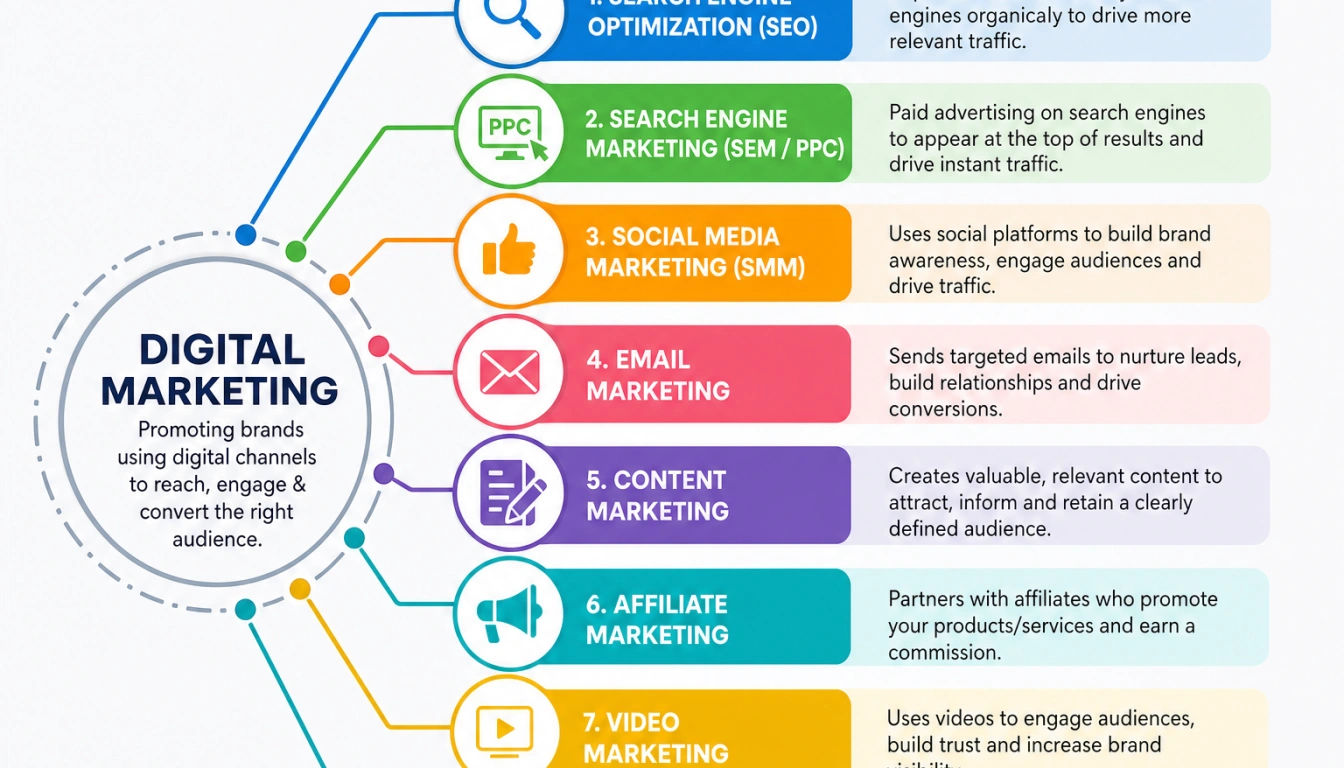
Here is the most important thing to understand about these branches: they are not separate silos. They are parts of an interconnected system.
A typical content marketing strategy relies on SEO to drive organic traffic to blog posts. Those blog posts include affiliate links (affiliate marketing) and calls-to-action to subscribe to an email list (email marketing). The email list is used to nurture subscribers and drive product purchases. Social media marketing amplifies the blog content to new audiences. Video content on YouTube supports the blog articles. Analytics tracks what is working across all of these channels.
When all branches work together toward a common goal, digital marketing becomes significantly more effective than any single channel used alone.
Which Branch of Digital Marketing Should You Learn First?
This is the most common question beginners ask, and the honest answer depends on your situation.
If you want a stable job quickly, learn Google Ads (SEM/PPC). It has the highest starting salaries in India and employers hire for this skill constantly.
If you want to build a blog or content business, start with SEO and Content Marketing. These two work together and form the foundation of any long-term organic traffic strategy.
If you want to become a freelancer quickly, learn Social Media Marketing. Every business in India needs someone to manage their Instagram and Facebook presence, and clients are relatively easy to find.
If you want passive income, focus on Affiliate Marketing combined with Content Marketing and SEO.
Google's free Digital Garage course is one of the best starting points available, and it covers multiple branches in a structured way at zero cost.
Branches of Digital Marketing: Quick Comparison Table
| Branch | Best For | Time to Results | Skill Level | Earning Potential (India) |
|---|---|---|---|---|
| SEO | Bloggers, businesses | 3 to 6 months | Intermediate | Rs. 15,000 to Rs. 1,50,000/month |
| SEM / PPC | E-commerce, startups | Immediate | Intermediate to Advanced | Rs. 30,000 to Rs. 2,50,000/month |
| Social Media Marketing | All businesses | 1 to 3 months | Beginner to Intermediate | Rs. 12,000 to Rs. 1,00,000/month |
| Content Marketing | Bloggers, B2B brands | 3 to 12 months | Beginner | Rs. 10,000 to Rs. 1,50,000/month |
| Email Marketing | All businesses | 1 to 4 weeks | Beginner | Rs. 10,000 to Rs. 80,000/month |
| Affiliate Marketing | Bloggers, creators | 3 to 12 months | Beginner | Variable, Rs. 5,000 to Rs. 3,00,000+/month |
| Influencer Marketing | Product brands | 1 to 4 weeks | Intermediate | Rs. 20,000 to Rs. 2,00,000/month |
| Video Marketing | All creators | 2 to 6 months | Beginner | Variable |
| Performance Marketing | E-commerce, fintech | Immediate | Advanced | Rs. 40,000 to Rs. 3,00,000/month |
| CRO | E-commerce, SaaS | 1 to 2 months | Advanced | Rs. 30,000 to Rs. 2,00,000/month |
| Analytics | All marketers | Ongoing | Intermediate | Rs. 20,000 to Rs. 1,50,000/month |
Common Misconceptions About Branches of Digital Marketing
"SEO is dead." This is repeated every year and it is consistently wrong. Google processes over 8.5 billion searches per day. SEO evolves constantly but it is far from dead.
"Social media marketing is just posting." Managing social media for a business involves strategy, content planning, community management, paid advertising, analytics, and continuous optimisation. It is a skilled profession.
"Email marketing is spamming." Effective email marketing is permission-based. People subscribe because they want to hear from you. Done correctly, it is the most personal and highest-converting channel in digital marketing.
"Digital marketing only works for big businesses." Some of the most successful digital marketing case studies in India come from very small businesses, individual bloggers, and solo freelancers who built significant income with minimal budgets.
"You need to learn all branches simultaneously." This approach almost always fails. Depth in one area always beats surface-level knowledge in all areas, especially at the beginning of your journey.
Expert Tips for Anyone Starting in Digital Marketing
Start with fundamentals before tools. Understanding why email marketing works is more valuable than knowing how to use five different email platforms.
Pick one branch, go deep, then expand. The most successful digital marketers are specialists who understood strategy deeply before expanding into adjacent areas.
Build something real. Start a blog. Run a small Google Ads campaign with Rs. 500. Create a social media account and grow it from zero. Theoretical knowledge without practical experience will not get you hired or clients.
Study your analytics obsessively. Data is the language of digital marketing. The marketer who understands what their data is telling them will always outperform the one who ignores it.
India is a unique market. WhatsApp, YouTube in regional languages, vernacular content, and mobile-first experiences matter here in ways they do not in the West. Tailor your strategies accordingly.
Frequently Asked Questions About Branches of Digital Marketing
1. How many branches of digital marketing are there?
There are 10 to 12 widely recognised branches of digital marketing, depending on how you classify them. The core branches are SEO, SEM/PPC, Social Media Marketing, Content Marketing, Email Marketing, Affiliate Marketing, Influencer Marketing, Video Marketing, Mobile Marketing, Performance Marketing, CRO, and Analytics. Some newer areas like AI marketing and voice search optimisation are emerging as additional disciplines.
2. Which branch of digital marketing is best for beginners in India?
For complete beginners, Social Media Marketing is the most accessible starting point because the platforms are familiar, the tools are mostly free, and there is high demand from small businesses in India. SEO combined with Content Marketing is the best choice for anyone who wants to build a long-term online income through blogging or freelancing.
3. Which branch of digital marketing pays the most in India?
Performance Marketing and SEM/Google Ads typically offer the highest salaries for professionals in India, with experienced specialists earning Rs. 1,50,000 to Rs. 3,00,000 or more per month. SEO specialists with strong track records and affiliate marketers with established content sites also earn very well.
4. Is SEO a branch of digital marketing?
Yes. SEO (Search Engine Optimisation) is one of the most important and foundational branches of digital marketing. It focuses specifically on improving a website's organic visibility in search engine results pages without paying for placement. It works closely with Content Marketing and Technical Web Development.
5. What is the difference between SEM and SEO?
SEO generates traffic organically through content optimisation and link building, without paying search engines directly. SEM uses paid advertising on search engines like Google to appear in search results immediately. SEO is a long-term investment; SEM delivers instant results but requires a continuous advertising budget.
6. Can a student learn digital marketing for free in India?
Yes, absolutely. Google's Digital Garage (learndigital.withgoogle.com), HubSpot Academy, Meta Blueprint, Coursera (with financial aid), and YouTube offer comprehensive free courses covering multiple branches of digital marketing. Many students in India have built full freelancing careers using skills learned entirely through free resources.
7. What is performance marketing and how is it different from digital marketing?
Performance marketing is a subset or branch of digital marketing where advertisers pay only for measurable results such as clicks, leads, sales, or app installs. It is not separate from digital marketing — it is one specialised discipline within it. Regular digital marketing encompasses all channels and strategies; performance marketing specifically focuses on paid, results-based campaigns.
8. How long does it take to master all branches of digital marketing?
Mastering all branches of digital marketing is a career-long journey because the field evolves constantly. Reaching a functional professional level in one branch typically takes 3 to 6 months of focused learning and practice. Becoming proficient across multiple branches generally takes 2 to 5 years of hands-on experience. The goal for most people should be deep expertise in one or two branches, with working knowledge of the rest.
Key Takeaways
- Digital marketing has 12 major branches, each serving a different purpose
- SEO builds long-term organic traffic; SEM delivers immediate paid results
- Social Media Marketing and Content Marketing are the most beginner-friendly branches in India
- Email marketing consistently delivers the highest return on investment of any digital channel
- Affiliate marketing is one of the best passive income strategies for Indian bloggers
- Performance Marketing and Google Ads offer the highest starting salaries for professionals
- All branches work best when they support each other as part of an integrated strategy
- Start with one branch, go deep, and expand from there
Wrapping Up
Understanding the branches of digital marketing is not just academic knowledge. It is the foundation of every smart decision you will make — whether you are choosing a career, building a business, growing a blog, or helping clients as a freelancer.
The good news is that you do not need to master all 12 branches to succeed. Thousands of Indian professionals earn substantial incomes specialising deeply in just one or two. The field is wide enough for SEO writers, Google Ads specialists, social media managers, email marketers, affiliate bloggers, and analytics experts to all thrive simultaneously.
Pick your branch. Commit to it seriously. Build something real with it. That is how careers and businesses get built in digital marketing — one focused skill at a time.
Disclaimer: Salary figures and earning estimates mentioned in this article are based on publicly available data from industry reports, job portals, and digital marketing surveys from 2025 to 2026. Individual results vary based on skill level, location, experience, and market conditions. This article is for informational and educational purposes only.
Related Articles on This Blog:
- How to Start Freelancing in India and Earn Money Online in 2026
- How to Do Keyword Research for Your Blog: Step-by-Step Guide
- Best Free Digital Marketing Courses in India for 2026
- How to Write SEO-Optimised Blog Posts That Actually Rank
- Affiliate Marketing for Indian Bloggers: Complete Beginner Guide
